




While newbies chase sharp price surges at the opening of trading sessions in London and New York, professional binary options traders prefer the quieter Asian market. The reason is simple: to make money on binary options, it's not the magnitude of the price movement that matters, but whether the price moves above or below the opening price of the option contract regardless of the size of the price movement. The Asian session creates ideal conditions for this. We'll discuss its features and hidden advantages in this review.
Content:
- Why the Pros Choose the Night: The Hidden Mechanics of the Asian Market.
- What to trade while Europe sleeps?
- Pocket Option and Quotex trading strategies for the Asian session.
- How news from China and Japan moves price charts.
- The Pros and Cons of Night Trading: Is It Worth Changing Your Hours for Profit?
- Conclusion.

Why the Pros Choose Night Trading: The Hidden Mechanics of the Asian Market
The Asian trading session has distinctive features that distinguish it from the European and American sessions. This primarily concerns the prevalence of flat and sideways price movements. This is due to the start of a new trading day, when the market "awakens" and forms the first significant price levels on relatively high volumes after an overnight lull.
The Asian session begins around 2:00 a.m. and continues until the opening of the European session. We discussed this in more detail in the article "The Best Time to Trade Binary Options." During this period, trading floors in Tokyo, Hong Kong, and Singapore are active, while major players from the US and Europe are virtually absent from the market. As a result, prices often move in narrow horizontal channels, which experienced binary options traders actively exploit when using a rebound strategy.
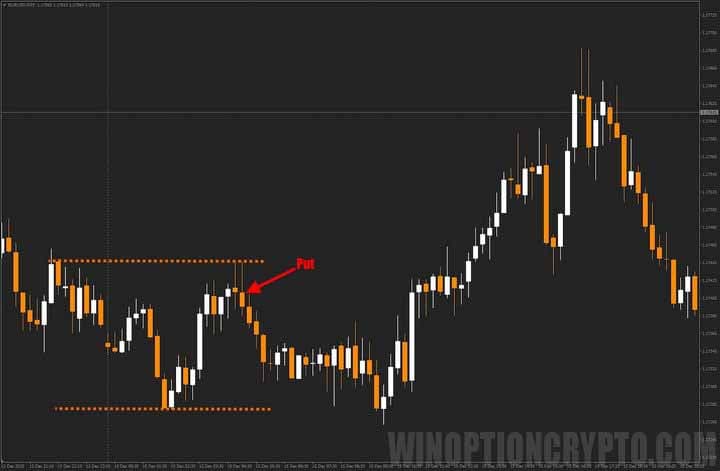
Another characteristic of the Asian session is the lack of important news from key global economies. Because of this, quotes for many currency pairs often move erratically during daytime trading hours. Liquidity is certainly lower at night, but this isn't a critical factor for binary options traders. Much more important is that prices move more smoothly during this period, with significantly fewer sudden price spikes. This allows traders using Pocket Option and Quotex to use one-minute and five-minute expirations with a lower risk of random price spikes.
Of course, this does not apply to currency pairs with the Japanese yen, Australian dollar and New Zealand dollar, since the publication of macroeconomic data from Japan, Australia and New Zealand can cause sharp jumps in the exchange rates of these currencies against the US dollar.
It's also worth remembering that the Asian session is when the Bank of Japan and the Reserve Bank of Australia are active. These regulators often set a clear trend for the entire trading session. Unlike the European session, where the market direction can change several times within an hour, the Asian trend is slower but still stable. This allows binary options traders to close entire series of trades in one direction with profit.
What to Trade While Europe Sleeps?
 When all European business centers are closed, volatility in major currency pairs significantly decreases, creating unique conditions for binary options trading. During this period, the market typically moves in narrow ranges, and breakout strategies tend to underperform during this period than rebound strategies.
It's important to remember that Japan is Asia's main financial center, so economic news from the country can trigger short-term price movements. The USDJPY currency pair is particularly active during the Asian session, often moving within predictable price ranges in the absence of important announcements from the Bank of Japan. 
In addition to the Japanese yen to the US dollar pairs, the EURJPY and GBPJPY cross rates are actively traded during this period. These currency pairs often experience more pronounced movements, but caution should be exercised when trading them due to the possibility of sharp price movements.
During the Asian session, trading in the Pacific currency pairs AUDUSD and NZDUSD intensifies. Their prices are sensitive to inflation, labor market, and interest rate data from Australia and New Zealand. Furthermore, these pairs are dependent on macroeconomic data from China. Typically, if weak data is released from Beijing between 3:00 and 4:00 AM (GMT+2), the AUDUSD and NZDUSD rates decline.
Pocket Option and Quotex Trading Strategies for the Asian Session
When trading on the Pocket Option and Quotex platforms, binary options traders should take into account the specifics of the Asian session. Classic trend indicators and market analysis methods often generate false signals during this time. Therefore, the primary focus of trading should be on counter-trend strategies and trading within horizontal channels.
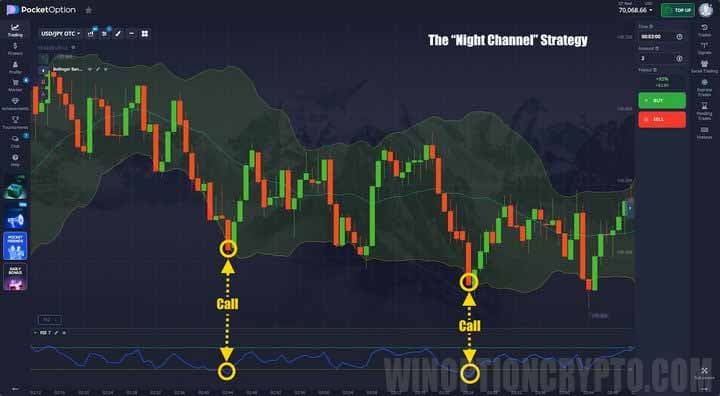
For example, traders at Pocket Option and Quotex brokers can use a simple "Night Channel" strategy based on two indicators: Bollinger Bands with a period of 20 and a deviation of 2, as well as RSI with a period of 7 and levels of 70 and 30.
To buy Call options, the candle must close below the lower channel boundary, and the Relative Strength Index (RSI) must be in the oversold zone — below 30. For Put options, the logic is reversed: you should wait for the candle to close above the upper channel boundary with the RSI value above 70.
When trading on the M1 timeframe, it's recommended to set the expiration to 3-5 candles, or 3-5 minutes. The EURUSD currency pair is best suited for this strategy, as it most often trades flat during this period.
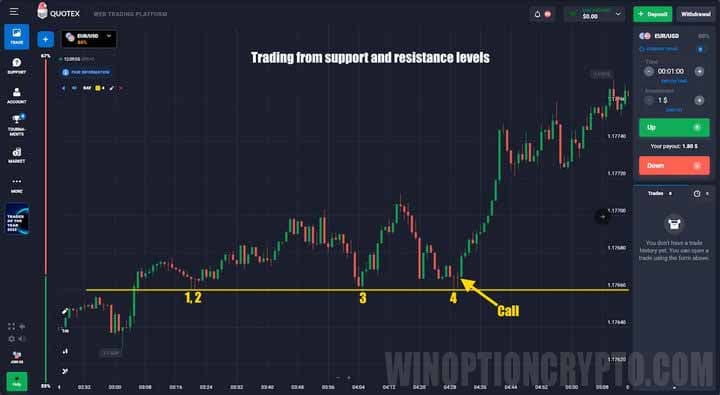
Another trading option is to open trades based on support and resistance levels. Price levels formed during this period typically perform quite accurately, so they can be used to find entry points. For example, on the Quotex platform, it's convenient to use the "Horizontal Line" drawing tool and plot the corresponding level on the chart.
After this, to open a trade, you should wait for three touches of the level and open a trade on the fourth. However, it's important to keep in mind that if the price "sticks" to a price level and remains near it for an extended period, the likelihood of a breakout increases significantly. Under such conditions, opening a trade becomes risky.
How News from China and Japan Moves Price Charts
To successfully trade during the Asian session, every binary options trader must consider the economic influence of China and Japan on the market. While European trading floors are closed, news from Tokyo and Beijing become the main drivers of price movements. China is the world's largest consumer of raw materials, so any statistical data from this country has a significant impact on the exchange rate of so-called commodity currencies, which include the Australian and New Zealand dollars.
For example, if China's business activity index or GDP figures are published above expectations, this boosts demand for raw materials and contributes to the rise of the AUDUSD and NZDUSD currency pairs. Conversely, weak economic reports from China often lead to a decline in the value of these assets, creating favorable conditions for entering into put options.
In turn, the active activity of the Japanese central bank and the yen's status as a safe-haven currency lead to increased volatility in the USDJPY pair during the Asian forex market session. If the Bank of Japan hints at tightening monetary policy, the yen begins to strengthen rapidly, leading to a decline in USDJPY prices.
Therefore, instead of relying solely on indicators, Pocket Option and Quotex traders should wait for the release of important economic data and analyze the initial market reaction. If news from China and Japan points in the same direction — for example, both regions are showing economic growth—this can set a short-term trend for the next 30-60 minutes after the data release. At such times, trading in the direction of price momentum with a 10-15-minute expiration is most effective, as fundamental factors outweigh technical indicator signals during this period.
The Pros and Cons of Night Trading: Is It Worth Changing Your Hours for Profit?
The advantages of night trading include the highly predictable market behavior during this period for European currency pairs. Due to the absence of major players from London and New York, price movements are rare. The Asian session is well suited for technical analysis enthusiasts, as support and resistance levels are broken significantly less frequently during this time, and the RSI and Stochastic oscillators provide clearer signals. Furthermore, night trading can be a good opportunity to combine trading with a full-time job.
The disadvantages of night trading are primarily related to the technical features of a particular binary options broker. The most common issue is reduced payouts on major currency pairs. Returns on EURUSD often drop by up to 60% during this period, making trading less profitable. From a health perspective, regularly disrupting sleep patterns negatively impacts a trader's well-being, leading to fatigue and stress. This increases the risk of deviating from a trading strategy: traders begin to "chase" the market and unnecessarily increase trade sizes, violating money management rules, which can ultimately lead to the loss of their deposit.
Conclusion
In summary, the Asian session is a unique time for binary options traders who prefer discipline and precise mathematical calculations to market chaos. While European and American business centers are closed, the market offers the opportunity to trade in calm conditions. Use binary options rebound strategies, monitor economic news from China and Japan, and wisely select assets on the Pocket Option and Quotex platforms. This will allow you to turn the "sleepy" time of day into a source of stable income.

To leave a comment, you must register or log in to your account.