




For binary options traders, the USDJPY currency pair offers truly unique opportunities. Many have fallen in love with it for its unique behavior, where the pair can remain in a narrow flat for hours, then suddenly make a strong impulsive move, often ignoring traditional technical indicator signals. Success in binary options trading on this asset is based on three principles, which you will learn about in this review.
Content:
- What makes the USDJPY pair unique for binary options traders?
- Tip #1: Enter a trade after consolidation
- Tip #2: Predict the Japanese Yen Exchange Rate Using the Dow Jones Index
- Tip #3: Use round numbers as support and resistance levels
- Conclusion

What Makes the USDJPY Pair Unique for Binary Options Traders?
Anyone who has ever traded the USD/JPY currency pair will have noticed its unique "character" compared to other assets. The reason for this pair's unique behavior lies in its dual nature. On the one hand, it is the result of the interaction between the world's two leading economies – the US and Japan. On the other hand, the yen has historically served as a safe haven during financial crises.
For binary options traders, this means that USDJPY exhibits pronounced strong directional moves: when panic occurs in the markets, the yen strengthens, creating a clear bearish trend for this pair and signals to buy Put options.
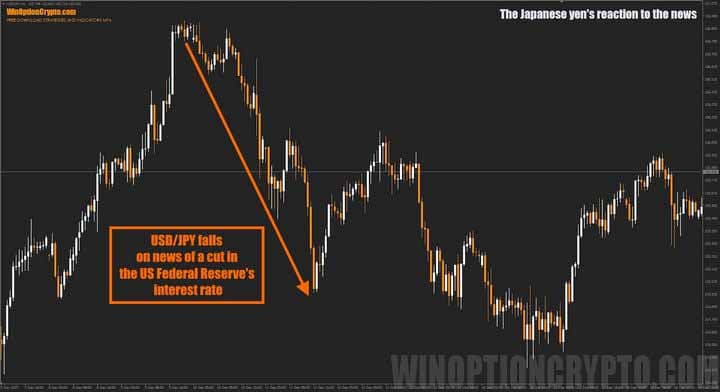
From a technical perspective, USDJPY differs from most major pairs. It is prone to forming prolonged, extended one-directional trends, which is especially important when trading with a fixed expiration time. While the EUR/USD pair experiences numerous false breakouts throughout the day, USDJPY moves within clear price channels. This allows binary options traders to more confidently determine entry points, basing their decisions on chart patterns, which work significantly better on this pair than on other assets.
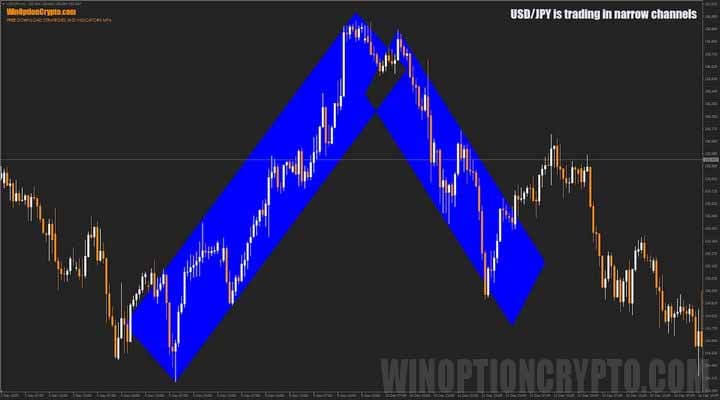
Another feature highly valued by experienced binary options traders is predictable intraday activity. Yen quotes follow a strict schedule during the Asian trading session, setting the trend direction for the entire day. Unlike most European currencies, whose exchange rates are dependent on the chaotic flow of news from numerous EU countries, USDJPY quotes respond to very specific triggers: decisions by the Bank of Japan and the US Federal Reserve. This makes analysis of the pair more straightforward and less susceptible to manipulation.
Tip #1: Enter a Trade After Consolidation
The USDJPY currency pair can remain stagnant for several days, then experience a sharp surge. Trading ranges like the one in the image below can be observed for this pair on various timeframes, and in some cases, they can last for several months. However, when the USDJPY price breaks out of the range, the movement can be very significant. Analyze the charts on higher timeframes to see this for yourself.
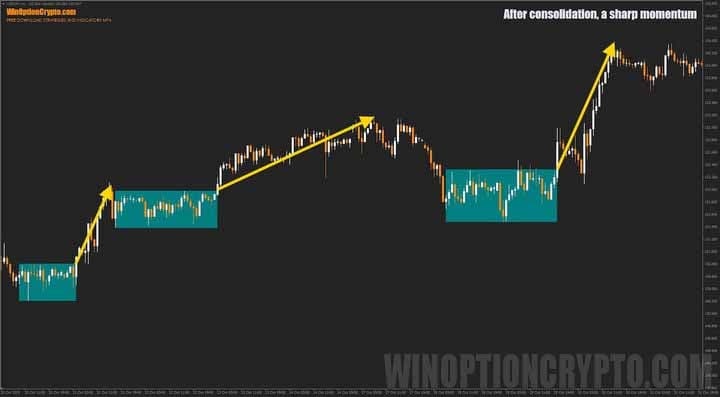
Such powerful impulse breakouts are ideal for short-term expiration trades on Call or Put contracts. To implement this simple strategy, binary options traders should learn to identify consolidation zones on the chart. These typically appear as flats. During these periods, large players, such as banks and hedge funds, accumulate their trading positions. The trader's task is not to try to guess the direction of price movement within this range, but to wait for the price to break through one of its boundaries.
The key signal for opening a binary options trade is the first candle closing outside the consolidation zone. If the candle closes above the upper limit, this is a signal to buy a Call option. If below the lower limit, buy a Put option. Volume acts as an additional filter. It's important that the breakout occurs on increased volume or is accompanied by a sharp increase in the candle's range. Set the expiration time within 3-5 candles of your working timeframe. This is sufficient time for the price to move a significant distance from the breakout point before a correction begins.
Tip #2: Predict the Japanese Yen Exchange Rate Using the Dow Jones Index
Note the relationship between the Dow Jones Industrial Average and the USDJPY currency pair. Typically, when investors sell off US stocks, the Japanese yen typically strengthens against the US dollar, and when stocks rise, this has a positive impact on the pair.
In the chart below, the daily candles represent the USDJPY currency pair, and the yellow line represents the closing prices of the Dow Jones Industrial Average.
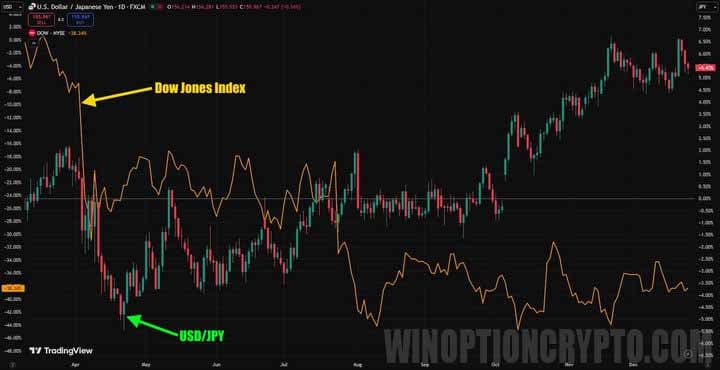
As you can see, in most cases they move in sync. This is due to global "risk appetite": when the US economy is thriving and stocks are rising, investors are eager to buy dollars and dump the "safe" yen. In this approach, the stock index acts as a leading indicator. Binary options traders can gain a certain advantage by monitoring the Dow.
For example, if the index breaks a local high and surges higher, this is a strong signal for the USDJPY pair to rise in the next 5-15 minutes. In this situation, traders who purchased a call option have an advantage because they are trading in tune with overall market sentiment.
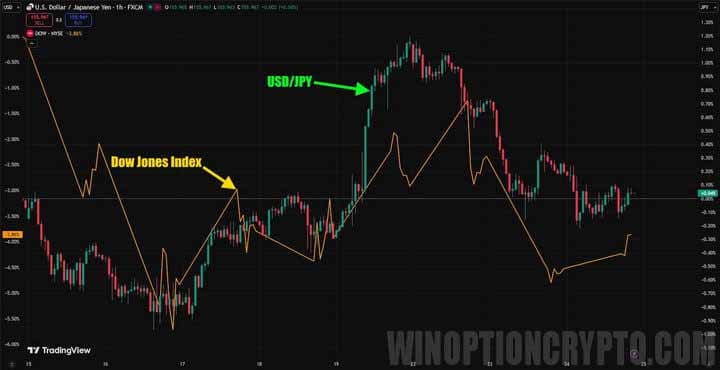
Moreover, this relationship persists even when switching to lower timeframes. Accordingly, trades on the USDJPY pair should be opened in the direction of the US stock index. However, remember: the correlation between these two instruments works best during the American Forex trading session.
Also, pay attention to the emergence of divergences between the Dow and the USD/JPY pair. If the index rises while the yen stagnates or declines, this is a sure sign that a powerful momentum is brewing in the currency market that will "catch up" with the US stock market.
Tip #3: Use Round Numbers as Support and Resistance Levels
Many binary options traders have likely heard about the importance of round numbers in forming support and resistance levels. If you're not familiar with this concept, we recommend reading the article "How to Use Support and Resistance Levels in Binary Options." In the USDJPY pair, such levels play a much more important role than in most other assets. This is due to the cultural characteristics of Japanese traders and the way the Bank of Japan tracks the exchange rate of the national currency.
To understand this, we first need to define what constitutes "round numbers." For the USDJPY pair, these are quotes with a trailing zero, such as 145.00, 150.00, or 152.50. These price levels are where significant pending orders from large commercial banks and exporting companies are concentrated, turning them into powerful barriers to exchange rate movement.
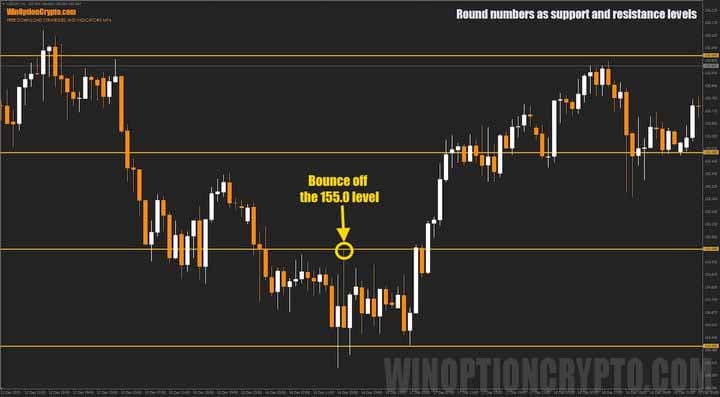
In binary options trading, such levels become good entry points for rebound trades, that is, reversals. For example, when the price approaches the 155 level from below, it rarely breaks through on the first attempt. More often, it "touches" and immediately reacts in the opposite direction, as can be seen in the chart above.
The strategy for working with these levels is quite simple: don't enter trades between them. Wait until the price approaches a value with two or three zeros at the end, such as 155.00 or 150.00. Check for the appearance of one of the reversal patterns in graphical analysis, such as the pin bar pattern, which we discussed in detail in the article "Using Pin Bars in Binary Options Trading," and open a trade on a rebound from the level.
Patience is key in this approach. The market tests traders' nerves, often making minor false breaks above round numbers before actually reversing. Therefore, binary options traders are advised to wait for the level to be touched and the price to react, then open a trade for 2-3 candles. This reduces market noise and takes advantage of large players' interest in round numbers, as they often serve as key benchmarks on the chart.
Conclusion
Overall, it's safe to say that trading the USDJPY currency pair is suitable for binary options traders who prefer a systematic approach to trading. By incorporating into your trading strategy rules for waiting for the price to break out of consolidation, monitoring the Dow Jones Index, and trading binary options at psychologically important levels, you'll lay a solid foundation for consistent results. Most importantly, remember: the yen rewards the patient and punishes those who ignore its connection to global financial markets.

To leave a comment, you must register or log in to your account.